
Research Data Management (RDM) encompasses the care and maintenance of research data to ensure high-quality results, long-term usability, and reproducibility beyond the original research project. It supports every phase of the research data life cycle, from planning to sharing, and ensures adherence to good research practices.
For additional references, see the full Knowledge Base on RDM.
Why RDM Matters
Robust RDM practices are essential for:
- Ensuring data quality, accessibility, and reusability.
- Promoting reproducibility, transparency, and rigor in research.
- Enhancing collaboration, data security, and storage efficiency.
- Preserving the scientific record and advancing open science.
Poor RDM practices can lead to consequences such as the retraction of publications, loss of valuable data, or the inability to reproduce research results.
Benefits of Good RDM
- For Researchers: Enhances visibility, reputation, and data ownership while meeting requirements from funders and publishers.
- For Projects: Improves clarity, coordination, and eligibility for funding.
- For Research Groups: Facilitates teamwork, knowledge transfer, and resource efficiency.
- For Society: Supports open science, reproducibility, and the preservation of scientific knowledge.
The Research Data Life Cycle
The research data life cycle illustrates the flow of data through a research project, highlighting key steps to ensure successful data curation and preservation. It consists of:
- Plan: Designing a data management plan (DMP) and outlining data collection and sharing protocols.
- Collect: Gathering primary or secondary data with clear metadata and data validation.
- Process and Analyze: Documenting workflows, software, and analysis steps to ensure transparency.
- Preserve: Storing data in standardized formats and preparing preservation documentation.
- Share: Publishing data securely while addressing copyright and access controls.
- Reuse: Leveraging data for follow-up research, education, and further analysis.
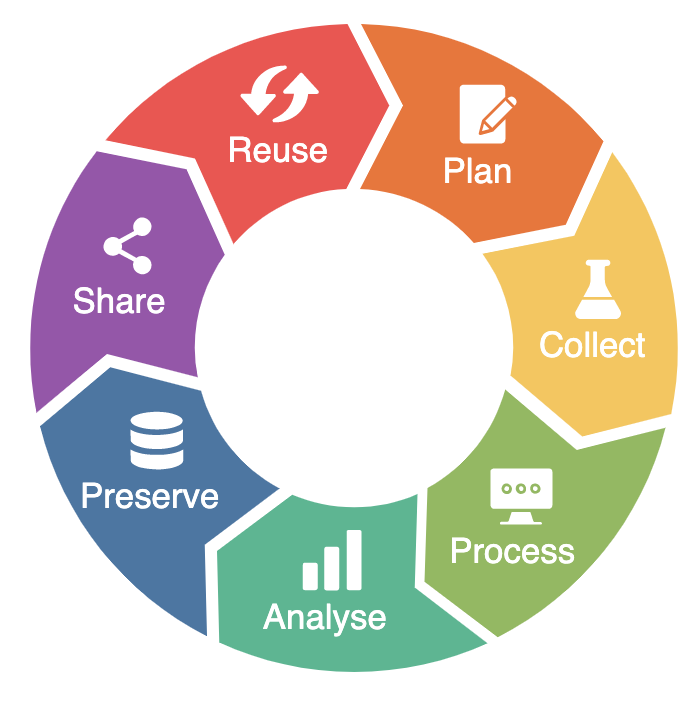
The life cycle emphasizes the importance of each step in preventing data loss and ensuring the reusability of results. Information provided by NFDI microbiota knowledgebase
Tools and Resources Along the Data Life Cycle
General Recommendations (NFDI4Microbiota)
- Plan: DMP template.
- Collect:
- Protocols.io.
- ELN workshops and training (e.g., eLabFTW).
- Process:
- Metadata management (Knowledge Base).
- GitHub-hosted workflows.
- Analyze:
- Cloud-based Workflow Manager (CloWM).
- Preserve:
- Reuse:
Challenges in RDM
Key challenges include:
- Navigating varying requirements from institutions and funders.
- Bridging gaps in tool interoperability.
- Ensuring sufficient institutional support and training.
References
- Brief Guide - Research Data Management
- RDMkit by ELIXIR
- Biernacka et al., 2020: Train-the-Trainer Concept on RDM
- RDMkit, 2021: Data Life Cycle
- Science Europe: RDM Practices