Research data management sounds like admin. It isn’t — it’s how you protect your thesis, publish faster, and turn your results into something the world can trust and build on. This page is the 5-minute version. Skim it, remember the rules of thumb, and follow a link only when you want the detail.
Why bother? (the 30-second case)
Good RDM isn’t paperwork for funders — it’s leverage for your research:
- Your thesis is safer. Backed-up, well-named, documented data can’t be lost, corrupted, or rendered meaningless the day you graduate and leave the lab.
- You work faster. Find any file in seconds; re-run an analysis with one command instead of wondering “which Excel did I edit last?”
- Your results are provable. A reproducible pipeline is the proof reviewers ask for — raw data to final figure, traceable end to end.
- Better, sharper science. Standardised, FAIR data is comparable across studies, generalisable, and reusable — it’s what makes meta-analyses, automation, and machine learning possible. Messy data can’t do any of that.
- You collaborate without friction. Shared standards mean a colleague — or future-you — understands your data without a 30-minute explanation.
- It compounds. Today’s clean dataset becomes tomorrow’s citable publication (with a DOI) and the next student’s starting point. That’s transparent, open, modern science — and it travels globally.
In one line: a little structure now buys you speed, trust, and reusable results later. And FAIR is only the exit standard — you owe nothing while data sits in your private space; the rules kick in when you share.
The rules of thumb
Memorise these seven. They’re ~80% of the benefit for ~20% of the effort. The “how to do each properly” lives in the detailed pages below — come back for them when you need them.
- Raw data is sacred — never edit it. Keep originals read-only, back them up, work on copies.
- Name things so a stranger understands — no spaces, dates as
YYYYMMDD, one consistent pattern. - One ID everywhere — the same sample/subject ID in your filenames, your metadata, and your lab notebook.
- Code, don’t click — every step from raw to result is a script you can re-run, not a manual edit you can’t.
- Write it down as you go — the lab-notebook entry and the README happen now, not “later”.
- Back up 3-2-1 — 3 copies, on 2 kinds of media, 1 off-site.
- FAIR when you share — metadata, a licence, and the right access level before anything leaves your private space.
Where to next?
Pick the card that matches what you’re doing. Each opens the full how-to.
Start a project
The day-one workflow, step by step.
Make my project FAIR
Tool-by-tool FAIR steps, plus a quick self-check.
Share or publish data
What to verify before data leaves your hands.
Write my DMP
A data management plan, pre-filled for the VRC.
See it done
Showcase subprojects, fully FAIR.
Handle sensitive data
GDPR, patient data, and the UKW boundary.
Our approach: the VRC and three pillars
DECIDE RDM rests on a simple model.
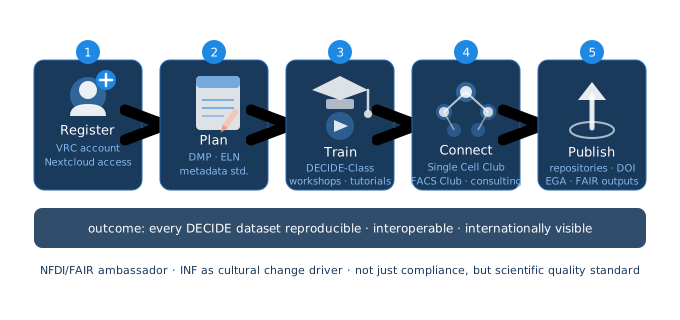
As a researcher you move your work through three pillars — Data (find it), Documentation (understand it), Analysis (reproduce it). cRDM makes that possible through three service pillars: a Knowledgebase (this site — SOPs and standards), the Infrastructure (the Virtual Research Campus: shared Nextcloud, JupyterHub, HPC and ELN, run together with Bioinformatics and combined with RZ/SMI services), and Training (WueCampus, workshops, consulting).
All of it rests on good scientific practice — and on three things the VRC is built to protect: data sovereignty (your data stays under your control, with fine-grained access you set), data security (patient-identifying data never leaves UKW — the VRC is for research data, not patient data), and collaborative, reproducible research.
This hub is run by the cRDM — core unit Research Data Management of the Medical Faculty (med.uni-wuerzburg.de/fdm). Using the VRC services means agreeing to the cRDM terms of use (Nutzungsordnung): Nutzungsordnung cRDM (PDF, DE).